
A powerboat spectacle in a Cardiff wasteland

Rhiwbina-based artist and designer David Hopkins recalls some of the experiences and events that have influenced and contributed towards the artworks he now produces and sells, which put a different perspective on familiar subjects.
The World Powerboat Championships were held in Cardiff in 1975 - 50 years ago.
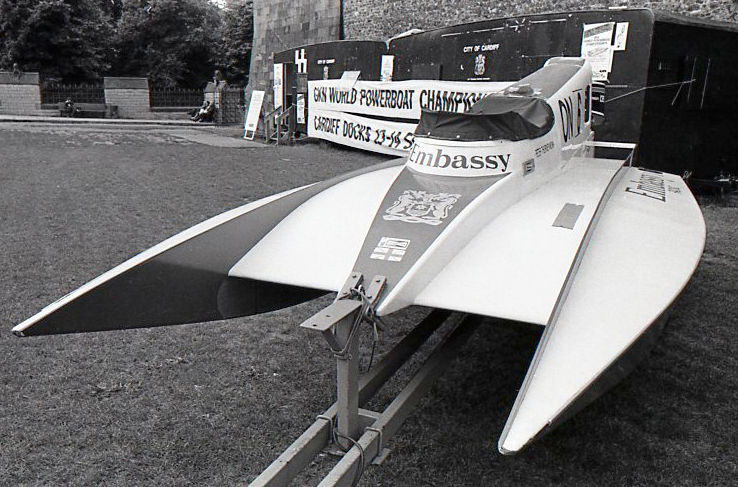
At the time, I was a student at Cardiff College of Art, and we had been given the task of creating our own design project during the summer holidays.
I knew the event was happening and, as I had an interest in all things noisy with an engine, I decided to cover the event photographically then redesign some of the marketing material as my project.
At the time, the promotion of the Championships seemed in line with what you’d expect from a major worldwide event dropping in for an appearance in your home city. In other words, not very much.

But these days the level of promotion would be considered at best inadequate and at worst a total absence of any form of hype whatsoever.
From what I remember, the event went off well enough, and I managed to do my project for college. But as some of the photographs show, the event was maybe a little less impressive than you’d expect from an international sports event today.
The ticket office was two tatty Cardiff Council caravans parked on the grass in front of Cardiff Castle, with banners strung loosely across the front and an F1 powerboat, sponsored by Embassy cigarettes, parked on its trailer next to the caravans. I don’t think I bought a ticket and I’m pretty sure that I just turned up on the relevant days and was let in to wander around the paddock where all the action seemed to be going on. Imagine being able to do that at a major sports event these days without your hi-viz photographer's vest or press pass.

The races themselves were held on Bute East Dock, which has since been disconnected from the main bay area but used to curve around towards the Pierhead building, through a couple of locks and a basin into what is now Cardiff Bay.
The dock area was still very much in a state of dereliction with none of the modernisation that has taken place since. The paddock area was covered in mud and stones, the dock edges were slippery, there were still the remnants of loading and unloading equipment getting in the way and, as you’d expect for a September weekend in Cardiff, it was wet and miserable.
The photos show some of these obstacles and highlight the importance with which health and safety initiatives were held back then. Still, the excitement of the event overcame any negative thoughts about the weather or the apparent lack of decent facilities for spectators, participants or media.

I recall what was described as a grandstand on the far side of the dock, plus a very impressive VIP seating section near the paddock, for those who felt they warranted that description, to get a really good view of all the action.
There were many opportunities to get reasonable photographs of some of the drivers of the powerboats, both in action and in the paddock, which for me as an inexperienced art student, I’m sure would be practically impossible now.
And I should point out, if you don’t know, that one of the genuine superstars of the sport was Roger Jenkins from Caerleon who went on to become Formula 1 Powerboat World Champion in 1982.

Roger was happy enough to have his photo taken in the paddock and I captured him again in his boat about to depart for a race.
In fact, many years later, I sent him a disk with digital images of my coverage of the event, and he rang me out of the blue to thank me and to say that very few images of the Cardiff event existed.

Sadly, Roger passed away in 2021 having survived many years in what was then a very dangerous sport.
He retired from racing in August 1984 after the Liege Grand Prix in Belgium that ended in the death of his friend and fellow driver Tom Percival, who I had seen and photographed racing in Cardiff.
Some of the photographs I took show the wasteland that Cardiff docks used to be, but even though the quality and sharpness may not be what I had hoped for, it was all part of the learning experience. And they provide a record that wouldn’t otherwise exist. I carried on taking photographs in and around areas of Cardiff, some of which are no longer there, and I am creating artworks and images from some of these originals to show how things were.
You can find out more about David's work here www.screamprint.co.uk


Comments